Yale Now Offers a Minor in Cutting Up Flannel Shirts and the Kids Are Calling It Scholarship
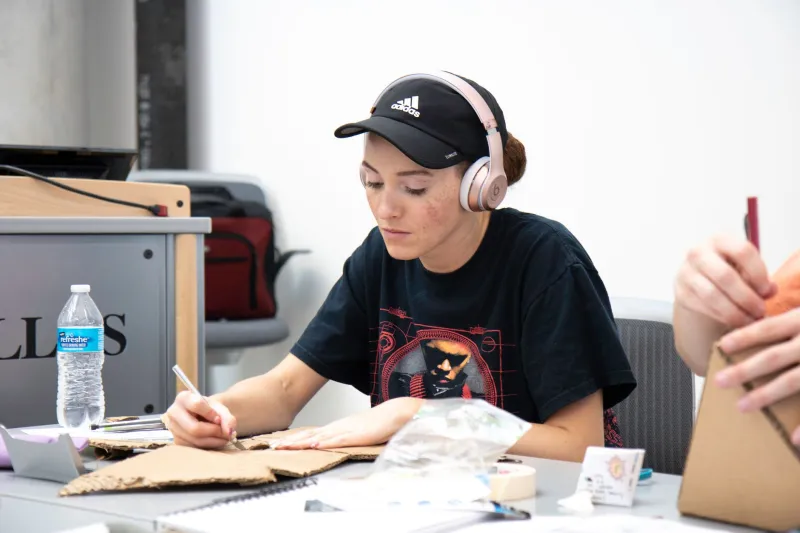
In the fall semester of 2025, the fictional Harwick University — a small, extremely prestigious liberal arts institution in Connecticut that we have invented for the purposes of this article but which you will absolutely believe is real — will launch its inaugural program in Circular Textile Narratives.
 Photo: Harwick University, via applybuds.com
The program, housed within the newly renamed Department of Sustainable Material Futures (formerly the Art Department, before the Art Department was rebranded for grant eligibility purposes), offers an accredited minor, a certificate track, and, pending faculty approval, a full bachelor's concentration.
The application requires a portfolio of "upcycled interventions." The tuition is $67,000 a year. The waiting list has 340 applicants.
Your aunt, who has been doing this in her craft room since 1994, has not been consulted.
The Syllabus: A Love Letter to Things That Were Already Free
Harwick's Circular Textile Narratives program is built around four core courses, each of which describes, with breathtaking academic confidence, activities that have been practiced by thrifty humans for the entirety of recorded history.
CTN 101: Deconstructive Textile Practice and the Post-Consumer Imagination Course description: "Students will engage with salvaged garments as sites of cultural inscription, exploring the semiotic potential of material transformation through hands-on deconstruction exercises."
In practice: students cut up secondhand clothing and sew it back together differently. There is a reading list. The reading list includes a 2019 Medium post.
CTN 204: Thrift Epistemology and the Circular Economy Course description: "An interdisciplinary examination of value creation within post-linear fashion systems, with attention to the labor, affect, and digital visibility economies that shape contemporary resale and upcycling practices."
In practice: students go to Goodwill, buy things, and write a 2,000-word reflection on how it felt. There is a guest lecture from a Depop seller with 40,000 followers who charges $400 for a flannel she bought for $3. The guest lecture is called "Disruption."
CTN 312: Advanced Seam Destruction and Regenerative Garment Theory Course description: "Building on foundational deconstruction techniques, students will develop individual upcycling methodologies and situate their practice within broader discourses of slow fashion, textile justice, and anti-capitalist material culture."
In practice: students use seam rippers. There is a final project. The final project is a jacket.
CTN 401: Senior Thesis in Circular Textile Narratives Course description: "Students will complete an original body of work synthesizing theoretical frameworks with material practice, culminating in a public exhibition and a 40-page critical essay."
In practice: students make things out of old clothes and write a very long paper about it. The exhibition is catered. The catering is locally sourced.
Meet the Faculty: Tenured, Earnest, and Extremely Committed to the Bit
Leading the program is Professor Dominic Ellers, who holds a PhD in Critical Fashion Studies from a university in the UK and has published extensively on what he calls "the radical poetics of the visible mend."
 Photo: Professor Dominic Ellers, via library.lums.edu.pk
Professor Ellers, reached for comment via a fictional press contact we invented for this article, was enthusiastic.
"What we're doing here is not craft," he said, in a way that suggested he has said this many times and will say it many more. "Craft implies a domestic, feminized, pre-theoretical practice. What we're doing is praxis. We are theorizing the seam. We are interrogating the hem. We are asking — and this is the central question of our program — what does it mean to cut?"
We asked if the answer was "to make something shorter."
He said that was a very reductive reading.
Associate Professor Kira Lund, who teaches CTN 204 and runs the program's community Depop shop (proceeds support the department's "material acquisition fund," which is a budget line for buying secondhand clothes), described the program's philosophy as "democratizing access to circular fashion literacy."
We noted that $67,000 a year was a somewhat unusual price point for democratization.
"The tuition reflects the institutional infrastructure," she said. "The knowledge itself is priceless."
"Isn't that a problem?" we asked.
"That's a great thesis topic," she said.
Student Profile: Pre-Med to Post-Consumer, One Flannel at a Time
Among Harwick's inaugural cohort of Circular Textile Narratives students is Jordan Ashby, 20, a sophomore who transferred out of the pre-med track in October after what Jordan describes as "a fundamental reckoning with what healing actually means."
"I was studying biology," Jordan explains, sitting in the program's studio space, which smells like vintage fabric and ambition. "And I kept thinking — the body is a system. Fashion is a system. Waste is a system. And nobody in pre-med was talking about the systems."
Jordan is currently working on a CTN 101 final project that involves deconstructing a men's XL flannel shirt and reassembling it into what Jordan describes as "a garment-length meditation on inherited masculinity and the post-industrial textile landscape."
It looks, at this stage, like a vest.
"It's not a vest," Jordan says. "It's a question."
Jordan's parents, both physicians, are supportive. Jordan's student loan debt is $134,000 and climbing. Jordan is not thinking about that right now. Jordan is thinking about the question.
Your Aunt Is Already Doing This and She Charges Nothing
The most clarifying way to understand the Circular Textile Narratives program — and the broader academic institutionalization of thrift culture it represents — is to call your aunt.
Specifically, the aunt who has been cutting up old jeans to make tote bags, turning her husband's worn-out dress shirts into quilts, and transforming thrift store sweaters into throw pillow covers since approximately the Clinton administration.
She does not have a PhD. She does not have a Depop shop. She does not use the word "praxis." She has a sewing machine, a bin of fabric scraps, and the practical conviction that throwing things away when you could fix them is wasteful.
She would be a natural fit for CTN 312.
She would also find the $67,000 tuition to be the funniest thing she has ever heard.
When we described the program to one such aunt — a real one, name withheld — she was quiet for a moment.
"So they're teaching kids to do what I've been doing for thirty years," she said.
"Yes," we said. "But with theory."
Another pause.
"What kind of theory?"
"The kind about what it means to cut."
The longest pause yet.
"I'll tell you what it means to cut," she said. "It means your scissors are sharp and you measured twice."
She has been offered a guest lecture slot in CTN 101.
The honorarium is $200.
She is considering it.