Milan's Hottest New Runway Show Stops Every Three Looks So Models Can 'Process Their Emotions'
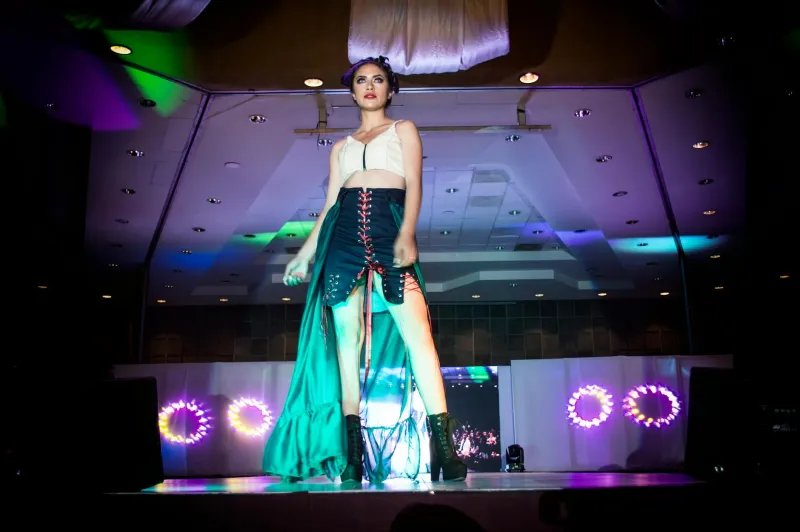
Milan's Hottest New Runway Show Stops Every Three Looks So Models Can 'Process Their Emotions'
Fashion Week has survived war, economic collapse, and the inexplicable return of low-rise jeans. But nothing — nothing — could have prepared the front row for what unfolded last Tuesday evening at the Palazzo Emozioni in Milan, when avant-garde design house Sentire debuted what industry insiders are already calling the most culturally significant — and clinically bewildering — runway show in living memory.
The collection was titled Cicatrice, Italian for 'scar.' The press notes described it as 'a sartorial journey through unresolved childhood attachment patterns, expressed in bias-cut silk and hand-dyed trauma.' The show lasted two hours and forty minutes. A standard runway show lasts twenty.
The difference? Every three looks, the music stopped, the lights softened to a warm amber, and a licensed therapist named Brecken walked onto the runway with a wicker basket full of leather-bound journals and artisanal felt-tip pens retailing at $78 each.
'We Ask That You Hold Space for the Garment'
The evening began innocuously enough. Model Anastasia K. opened the show in a floor-length charcoal wool coat with asymmetrical lapels and a single raw hem — genuinely stunning, genuinely wearable, a look that might have launched a thousand Pinterest boards. She reached the end of the runway, paused, pivoted, and then — stopped.
Brecken appeared.
'Anastasia is going to take a moment,' he announced into a microphone shaped like a vintage perfume bottle. 'She's noticing some activation in her chest around the construction of this sleeve. We're going to honor that.'
Anastasia sat cross-legged on the runway in a $6,200 coat and began writing in her journal.
The audience, which included three Vogue editors, a duchess of minor European nobility, and a TikTok creator with 14 million followers who had been comped a front-row seat in exchange for content, sat in total silence for four minutes.
Then the music resumed. The next model emerged.
This happened eleven more times.
The Designer Behind the Breakdown
Sentire's creative director, Florian Voss — a Berlin-born, Los Angeles-based designer who famously spent eighteen months at a somatic healing retreat in Ojai before launching his label — spoke to press after the show from a dimly lit anteroom where someone had placed a bowl of warm stones.
'People keep asking me what the collection means,' Voss said, swirling an oat milk cortado. 'But meaning is a defense mechanism. What I wanted was for people to feel the fabric. Not intellectually. Somatically. In their nervous systems.'
When asked about the price points — the entry-level piece, a linen tank top, retailed at $890 — Voss nodded slowly and said, 'Healing isn't cheap. Neither is hand-loomed Belgian linen.'
His publicist, who had been standing nearby holding a diffuser emitting something called 'regulated cedar,' added: 'The collection is the healing.'
She said this without irony. We checked.
The Grounding Exercise That Stopped the Show (Literally)
The evening's most dramatic moment came during Look 27, a sculptural ivory evening gown with a twelve-foot train made from recycled parachute silk. Model Dasha P. had made it approximately halfway down the runway when Brecken reappeared — this time with a singing bowl.
'We're going to do a brief grounding exercise,' he said. 'If you'd like to participate from your seat, please feel your feet on the floor. Notice five things you can see. Four things you can touch. Three things that bring you shame about your relationship with luxury consumption.'
A buyer from a prominent Dallas department store later told us she had, in fact, identified three things. She declined to share them but described the experience as 'aggressively uncomfortable and also kind of effective, which made it worse.'
The Duchess left during the singing bowl portion. Her publicist released a statement saying she had a prior engagement. The statement was issued at 9:47 p.m.
The Finale: A Group Hug in $4,000 Linen
By the time the finale arrived, the audience had been sitting for two hours and twenty minutes, had consumed approximately zero canapés (the catering team had been replaced by a 'nourishment facilitator' who offered only warm broth and something called 'grief crackers'), and had collectively experienced what one editor described as 'a hostage situation with excellent tailoring.'
All twenty-two models returned to the runway simultaneously, each wearing a variation of the same oversized linen set in a shade Sentire's lookbook described as 'Unresolved Beige.' They stood in a loose cluster at the end of the runway.
Brecken spoke one final time.
'Florian asks that we close this experience as a community. Models, if you feel called — and only if you feel called — please embrace.'
They embraced. All twenty-two of them. In $4,000 linen sets. For approximately ninety seconds.
The front row did not know whether to applaud or refer someone to a crisis line. They did both, sequentially.
The Reviews Are… Something
Critical response has been, to put it generously, varied. Runway Digest called it 'the most important fashion statement since the introduction of the power suit.' A prominent menswear blogger described it as 'two and a half hours I will never get back, plus I cried during Look 14 and I'm still angry about it.' One anonymous buyer simply submitted a review consisting of the word 'why' repeated forty times.
The collection sold out in six hours. The journals are backordered until March.
Florian Voss has announced that next season's show will incorporate 'attachment style assessments' into the seating chart, meaning guests will be placed based on whether they are anxious, avoidant, or secure. VIP seating will be reserved exclusively for those who are 'actively doing the work.'
We have reached out to ask who determines whether someone is actively doing the work. We have not heard back. Brecken is, presumably, unavailable. He is holding space for something.