The Dawn of Dress Code Dystopia
Remember when wedding invitations said "black tie" and everyone knew what that meant? Those were simpler times, before couples discovered they could weaponize their wedding aesthetic against their loved ones through increasingly unhinged dress code requirements that sound like rejected Anthropologie collection names.
Welcome to 2024, where "Whimsical Black Tie" is a real phrase that real humans have written on real invitations, and somewhere in America, a bridesmaid is having a panic attack in a Nordstrom fitting room because she can't figure out what "Coastal Grandmother Gala" means.
The Rise of the Wedding Dress Code Consultant
In a development that perfectly captures our collective descent into madness, "Wedding Dress Code Consultant" has become an actual profession. These modern-day translators charge between $150-$500 to decode what your friend meant when they requested "Garden Party Noir" or "Rustic Glamour with Bohemian Undertones."
Sarah Chen, founder of Decoded Dress Codes, has built a six-figure business interpreting wedding fashion hieroglyphics for confused guests. "I started this after spending $1,200 on an outfit for a 'Vintage Modern Ethereal' wedding, only to show up looking like I was attending a completely different event," Chen explained. "Turns out 'vintage modern' meant '1990s minimalism,' not '1920s flapper,' and 'ethereal' apparently translated to 'beige.'"
 Photo: Sarah Chen, via lastfm.freetls.fastly.net
Her most challenging assignment to date? A wedding with the dress code "Sunset Meets Symphony Meets Your Mom's Garden Party But Make It Fashion." Chen spent three hours on a consultation call and eventually recommended "business casual in warm tones with a floral accessory."
The guest still got it wrong.
Facebook Groups: Where Dreams Go to Die
The phrase "What do I wear?" has spawned entire Facebook ecosystems where wedding guests gather to collectively lose their minds over dress code interpretations. The group "Wedding Guest Outfit SOS" has 47,000 members who spend their days posting photos of potential outfits with captions like "Is this too much for 'Elevated Casual Chic'?" and "Help! Does this scream 'Boho Luxe' or just 'confused tourist'?"
The comment sections are war zones where strangers debate whether a floral midi dress is appropriate for "English Garden Romance" or if it crosses into "trying too hard" territory. One recent post about "Tropical Formal" received 312 comments and no clear consensus, leaving the original poster to attend the wedding in what she described as "a prayer and a sundress."
Moderator Jessica Williams has watched the group evolve from helpful fashion advice to something resembling a support group for the fashion-traumatized. "I've seen grown women cry over the phrase 'festive attire,'" Williams said. "Last month, someone posted asking if 'Creative Black Tie' meant they should bedazzle a tuxedo. The fact that it was a legitimate question tells you everything you need to know about where we are as a society."
The Psychology of 'Creative Black Tie'
Dr. Miranda Hoffman, a clinical psychologist who specializes in social anxiety, has noticed an uptick in patients seeking therapy for "wedding guest outfit trauma." The trigger phrase that sends most people over the edge? "Creative Black Tie."
 Photo: Dr. Miranda Hoffman, via mirandahoffmanjung.com
"It's the ultimate contradiction," Dr. Hoffman explained. "Black tie has specific rules. Creative means breaking rules. Asking someone to do both simultaneously is like asking them to be simultaneously sitting and standing. It creates a cognitive dissonance that can trigger genuine anxiety responses."
One of her patients, who requested anonymity, described the mental breakdown that followed receiving an invitation with a "Creative Black Tie" dress code: "I spent three weeks researching. I joined Pinterest boards. I watched YouTube tutorials. I bought and returned seven different outfits. By the wedding day, I was convinced that everyone would know I was a fraud who didn't understand fashion. I ended up wearing a regular black dress and crying in the bathroom during cocktail hour."
The couple later admitted they weren't entirely sure what "Creative Black Tie" meant either. They just "liked how it sounded."
When Good Intentions Go Very, Very Wrong
The road to dress code hell is paved with couples who think they're being helpful by providing "guidance" for their guests. Take Brad and Melissa Thompson, who thought they were being considerate when they included a full paragraph explaining their "Rustic Elegance" theme.
"We wanted people to feel comfortable but still look nice," Melissa explained. "So we wrote: 'Think upscale barn party meets countryside sophistication. Elegant but not stuffy, refined but not pretentious, polished but not overdressed. Aim for that perfect balance between effortless and intentional.'"
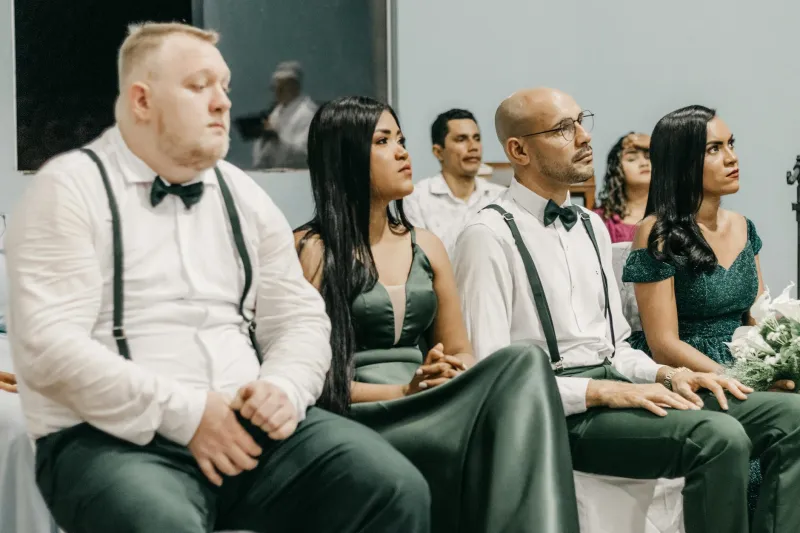
What they got was a wedding that looked like a costume party where everyone came dressed as a different interpretation of the same incomprehensible character. One guest showed up in a ballgown with cowboy boots. Another wore a three-piece suit with a straw hat. The maid of honor described the overall effect as "aggressively confusing."
The Great Interpretation Disasters of 2024
This year has been particularly brutal for dress code misunderstandings. The "Enchanted Forest Formal" wedding where half the guests showed up in floor-length gowns and the other half in hiking boots. The "Modern Vintage" celebration that looked like a time-travel convention gone wrong. The "Whimsical Sophistication" reception where someone genuinely wore a tutu with a blazer because they interpreted "whimsical" literally.
But perhaps the most catastrophic misunderstanding involved a couple who requested "Casual Elegance" for their beach wedding. Guests interpreted this as everything from sundresses to full suits, resulting in what one attendee described as "the most uncomfortable game of fashion roulette ever played on sand."
The bride later admitted she meant "nice sundress or khakis," but by then the damage was done. The wedding photos look like a documentary about people from different planets trying to attend the same event.
The $800 One-Time Outfit Economy
The economic impact of incomprehensible dress codes cannot be understated. The average wedding guest now spends $347 on an outfit they'll wear exactly once, largely because they're too traumatized by the possibility of getting it wrong to risk rewearing anything that might not perfectly capture "Bohemian Luxe" or "Garden Party Glam."
Retailer data shows that searches for "what to wear to [insert nonsensical dress code]" have increased 340% over the past two years. Nordstrom has started offering a "Wedding Guest Emergency" personal shopping service, and Rent the Runway has added a "Decode the Dress Code" feature to their app.
"People are spending money they don't have on clothes they don't understand for events where they're guaranteed to feel inappropriately dressed," said fashion economist Dr. Patricia Reynolds. "It's a perfect storm of anxiety, capitalism, and the human desire to not be the person who shows up wrong."
The Ceasefire That Never Comes
As wedding dress codes continue their evolution into abstract poetry, guests have begun developing coping mechanisms. Some have started attending weddings in "safe" black outfits regardless of the stated dress code. Others have formed outfit-sharing groups where friends collectively interpret and execute dress code requirements.
But the arms race continues. Couples, apparently unaware that they're causing psychological damage, keep pushing the boundaries of dress code creativity. Recent invitations have included requests for "Sunset Ceremony Chic," "Organic Glamour," and the truly inexplicable "Elevated Casual Formal."
Until someone calls for a dress code ceasefire, American wedding guests will continue to wander the fashion wasteland, clutching their Pinterest boards and praying that their interpretation of "Romantic Industrial" doesn't result in social exile.
The war rages on, and there are no survivors—only people who look vaguely appropriate and those who definitely don't.