I Let a 'Color Season Analyst' Diagnose My Soul for $800 and Now I'm Legally a Winter
The Moment I Realized I'd Been Living a Lie
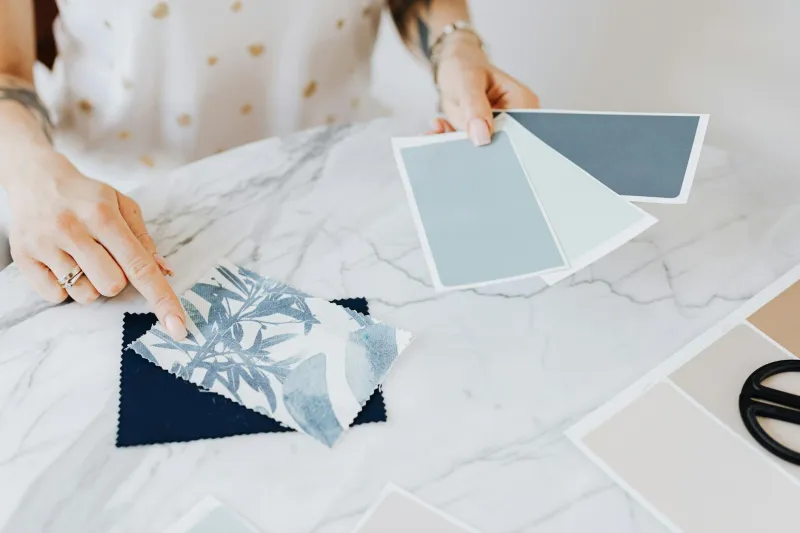
It happened on a Tuesday at 2:47 PM in a converted garage in Sherman Oaks, surrounded by more fabric swatches than a Project Runway fever dream. That's when Crystina—yes, with a 'y'—held up a piece of navy blue fabric next to my face and delivered the news that would change everything: "Oh honey, you're definitely a Winter. I can see it in your aura."
 Photo: Sherman Oaks, via taboohome.net
Just like that, forty-three years of thinking I looked good in warm colors evaporated like my checking account balance. For $800, I had just learned that my soul was apparently navy blue, my chakras were misaligned with my closet, and every compliment I'd ever received was a lie told by people too polite to mention I was wearing the wrong undertones.
Welcome to the booming world of personal color analysis, where trained professionals charge more than most people's rent to drape fabric near your face and inform you that you've been committing fashion crimes against your own DNA.
The Science of Expensive Validation
Personal color analysis isn't new—it's a relic from the 1980s that somehow survived the fall of shoulder pads and the rise of common sense. The theory goes like this: every person falls into one of four "seasonal" categories based on their skin's undertones, and wearing colors that match your "season" will make you look radiant, youthful, and like someone who has their life together.
What is new is the price point and the pseudoscientific language that makes it sound like these consultants have PhDs in chromotherapy instead of weekend certifications from online courses. Crystina, who charges $800 for a two-hour "Comprehensive Color Journey," explained that she uses "advanced spectral analysis" to determine my "chromatic DNA signature." This turned out to be her holding up fabric squares while squinting at my face like she was trying to solve a particularly challenging sudoku puzzle.
The consultation began with what Crystina called a "color confession"—a therapy session where I had to admit all the ways I'd been "chromatically self-sabotaging." Apparently, my love affair with earth tones was actually a symptom of deeper issues. "When we wear the wrong colors," she explained while lighting a candle that smelled like expensive mistakes, "we're literally dimming our inner light. Your burgundy sweater isn't just unflattering—it's energetically violent."
The Fabric Inquisition
The actual analysis involved Crystina draping approximately 847 different fabric swatches around my shoulders while I sat perfectly still like a very expensive mannequin. Each swatch came with a verdict delivered in the tone of someone announcing terminal illness: "This coral is absolutely devastating on you," or "This yellow is committing hate crimes against your complexion."
The process was surprisingly emotional. Watching Crystina's face scrunch up in horror every time she held up a warm-toned fabric made me question everything I thought I knew about myself. Had I really been walking around for decades looking like a walking advertisement for poor life choices? Was my favorite rust-colored jacket actually a cry for help?
The breakthrough moment came when she draped a piece of what she called "True Winter Navy" across my shoulders. Her entire demeanor changed—she gasped, stepped back, and clutched her color wheel like it was a sacred text. "There she is!" she whispered. "There's your authentic self!"
Looking in the mirror, I had to admit something was different. Maybe it was the lighting, maybe it was the $800 I'd already spent, or maybe it was the sheer relief of finally reaching a conclusion after two hours of fabric torture, but I did look... better? More awake? Like someone who might actually know what thread count means?
The Winter Personality Diagnosis
But Crystina wasn't done. According to her "proprietary personality-color correlation system," being a Winter meant I was "naturally commanding, intellectually sharp, and energetically crystalline." She handed me a 23-page booklet explaining my "Winter Characteristics," which read like a horoscope written by someone with a serious fabric addiction.
Apparently, Winters are "drawn to clarity and precision," which explained why I liked my coffee black and my spreadsheets color-coded. We're also "naturally magnetic leaders" who "command respect through our chromatic choices." The fact that I'd been wearing warm browns was apparently why I'd never been promoted to management—my wardrobe was literally sabotaging my career trajectory.
The booklet also included a list of "Winter Lifestyle Recommendations," which felt suspiciously like suggestions for expensive purchases. Winters should invest in "architectural jewelry," "statement eyewear," and "power pieces in your signature palette." Coincidentally, Crystina just happened to sell a "Winter Starter Kit" for $1,200 that included all these essentials.
The Conversion Experience
I left Crystina's garage-turned-temple with my new identity, a shopping list longer than a CVS receipt, and the unsettling feeling that I'd just joined a very expensive cult. But here's the thing: it worked. Sort of.
For the next month, I committed fully to my Winter identity. I bought navy blazers, black turtlenecks, and enough silver jewelry to set off airport metal detectors. I threw out my beloved earth-toned sweaters with the fervor of someone disposing of evidence. I even started introducing myself differently: "Hi, I'm Sarah, and I'm a Winter."
The results were... confusing. People did compliment my new look, but I couldn't tell if it was because I actually looked better or because I was walking around with the confidence of someone who'd just spent $2,000 to be told they were special. The placebo effect is a powerful thing, especially when it's wearing the right undertones.
The Seasonal Identity Crisis
Three months into my Winter era, I started having doubts. Was I really living my "authentic chromatic truth," or had I just been successfully marketed to by someone with a very convincing fabric collection? The turning point came when I caught myself judging other people's color choices with the righteousness of a recent convert. I found myself mentally categorizing strangers by their seasonal failures, thinking things like "That woman is clearly a Spring wearing Autumn colors—how tragic."
That's when I realized I'd crossed the line from customer to evangelist. The color analysis industry doesn't just sell you a palette—it sells you an identity, a community, and most importantly, a reason to judge everyone who hasn't been properly "analyzed." It's multilevel marketing disguised as self-discovery, with fabric swatches instead of essential oils.
The True Cost of Chromatic Clarity
Looking back, my $800 color analysis wasn't really about finding my perfect palette—it was about buying certainty in an uncertain world. In a culture obsessed with optimization and "authentic self-expression," the promise that someone could scientifically determine my ideal colors was irresistible. It offered the fantasy that there's a perfect version of myself waiting to be unlocked, and all I needed was the right shade of blue.
But here's what Crystina's 23-page booklet didn't mention: confidence isn't something you can drape around your shoulders. The real magic wasn't in the navy fabric—it was in spending two hours having someone pay attention to how I looked and tell me I was worth analyzing. The $800 wasn't for color theory; it was for the experience of being seen and categorized and declared officially special.
Am I still a Winter? According to my closet, absolutely. According to my bank account, it was an expensive lesson in the power of professional validation. And according to my mother, who's been telling me to wear more navy for twenty years, I just paid someone $800 to agree with her.
The real seasonal truth? Sometimes the most authentic thing you can do is admit you have no idea what you're doing, and that's perfectly fine in any color palette.