The $6,000 'Thrift Haul': A Forensic Breakdown of How Influencers Are Performing Poverty With a Full Production Crew and a Fake Goodwill Tag

The $6,000 'Thrift Haul': A Forensic Breakdown of How Influencers Are Performing Poverty With a Full Production Crew and a Fake Goodwill Tag
The video opens on a parking lot. The influencer — let's call her Brynn, because statistically there is a 40 percent chance her name is Brynn — steps out of a car, looking adorably disheveled in what the caption will later describe as 'literally just threw this on.' She adjusts the straps of a canvas tote. She pushes open a glass door. The thrift store sign glows behind her like a beacon of democratic possibility. 'Okay you guys,' she says, voice tilted upward with barely contained excitement, 'I have no idea what we're going to find today.'
Brynn knows exactly what they're going to find today. Brynn's team has been at this location for three hours. The items have been pre-selected, pre-tagged, and in at least two cases, pre-purchased at full retail price and then physically transported to this Goodwill so that Brynn can 'discover' them on camera. The lighting rig is just off frame. The sound engineer is in the next aisle pretending to look at ceramic figurines. The production budget for this video about thrifting on a budget is $6,000.
Welcome to the most expensive performance of frugality in the content economy.
The Anatomy of a 'Spontaneous' Haul
The thrift haul video is one of the most durable formats in lifestyle content, and its durability is not accidental. It hits every emotional note that the algorithm rewards: relatability, discovery, transformation, and the implicit promise that you too could stumble into a vintage Levi's jacket for $3.50 if you just had the right energy and a camera crew.
At the micro level — the actual small creator filming themselves on a phone, genuinely excited about a $6 blazer — the format is exactly what it appears to be. But somewhere around the 500,000-follower mark, something shifts. The production values creep up. The lighting gets better. The finds get more consistently remarkable. The tags get harder to read.
At the macro level — the mid-to-large influencer with a talent agency, a brand deal pipeline, and a production team on retainer — the thrift haul has become a genre of fiction. A very specific, very lucrative fiction in which the performance of budget shopping is itself a premium product.
The Full Cost Breakdown, Line by Line
Let's run the numbers on a mid-tier lifestyle influencer's 'spontaneous' thrift haul, based on standard industry rates and the kind of production infrastructure that a creator with 800,000 followers typically maintains.
Location scouting and coordination: $400. Someone had to call the store, negotiate filming access, identify the most photogenic aisles, and confirm that the lighting near the denim section was workable. That someone billed hourly.
Production crew (videographer, sound, lighting): $1,800. A three-person crew running a half-day shoot at standard rates. The 'candid' shots of Brynn holding up a questionable sweater with her head tilted in exaggerated consideration? Those required three takes and a lighting adjustment.
Props coordinator and item sourcing: $600. This is the line item that should make you sit down. Several documented cases in the content industry involve items being sourced specifically for haul videos — either purchased at other thrift stores and transported, or in more egregious instances, purchased at retail and artificially aged. The Goodwill price tag, in these cases, is a prop. It was applied with a glue gun by a person who was paid to do that.
Talent agency commission on brand deal attached to video: $1,200. The thrift haul is often sponsored. Not by Goodwill. By a fast fashion brand, a sustainable clothing app, or occasionally a financial services company that has identified 'budget-conscious millennials' as a target demographic. The irony of a sponsored frugality video is apparently not a dealbreaker for anyone involved.
Post-production editing: $800. The color grading alone on a thrift haul video — specifically calibrated to make fluorescent retail lighting look warm and golden and full of possibility — is a minor technical achievement.
Items 'purchased' on camera: $200-$1,000. Some of these are genuinely thrifted. Some are not. All of them were selected in advance. The $4 blouse that Brynn holds up to the camera with the reverence of someone who has found the Holy Grail? It was waiting for her.
Total: approximately $5,000 to $6,200, before Brynn's own day rate.
The Audience That Keeps Watching
Here is the genuinely interesting question: does the audience know?
Some of them do. The comment sections on large thrift haul videos now contain a running forensic commentary — viewers zooming in on price tags, identifying brand labels, noting that the store in the background is a Goodwill that closed in 2022 and has since been a Planet Fitness. There are entire Reddit threads dedicated to cataloging the inconsistencies. The skeptic economy around influencer thrift hauls is nearly as robust as the haul economy itself.
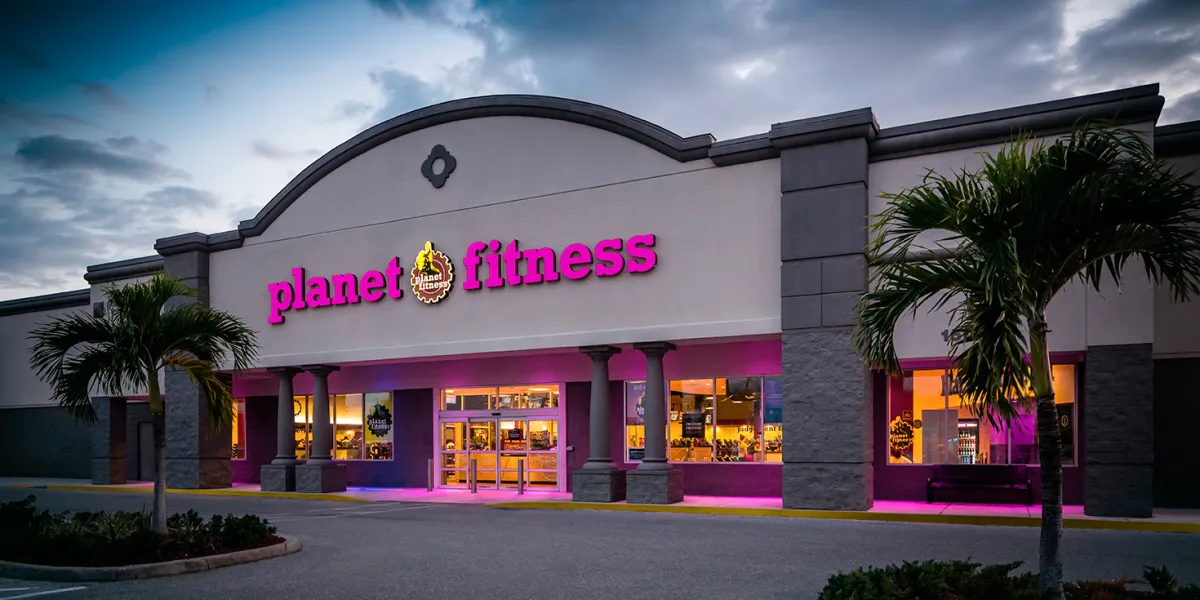 Photo: Planet Fitness, via static6.businessinsider.com
And yet the views keep climbing. The saves keep accumulating. The brand deals keep landing.
Because the audience, ultimately, is not watching for the $4 blouse. They're watching for the feeling the $4 blouse represents — the fantasy of the lucky find, the democratic possibility that good taste doesn't require money, the soothing fiction that somewhere out there, a great coat is waiting in a bin for the right person to notice it.
Brynn is selling that feeling. The thrift store is the set. The price tag is a costume.
The Performers Who Are Getting Sloppy
The production errors are becoming more frequent, which suggests either increasing carelessness or the dawning realization that the audience doesn't actually care.
A creator with 1.2 million followers recently posted a 'spontaneous' Goodwill haul in which a blazer visible in the background was still wearing its Saks Fifth Avenue security tag. Another's 'thrifted' handbag appeared in the video with a visible dust bag from a luxury resale platform. A third's 'local Goodwill' was identified by eagle-eyed viewers as a set-dressed storage unit in Burbank.
The corrections were posted. The apologies were vague. The follower counts were unaffected.
Brynn, for her part, has a new video dropping Thursday. She found the most incredible vintage jacket for $6. You're not going to believe it.
The props coordinator has already applied the tag.