Wedding Guests Are Dropping $900 on 'Threat Level Assessment' Stylists to Avoid Accidental Bride Upstaging
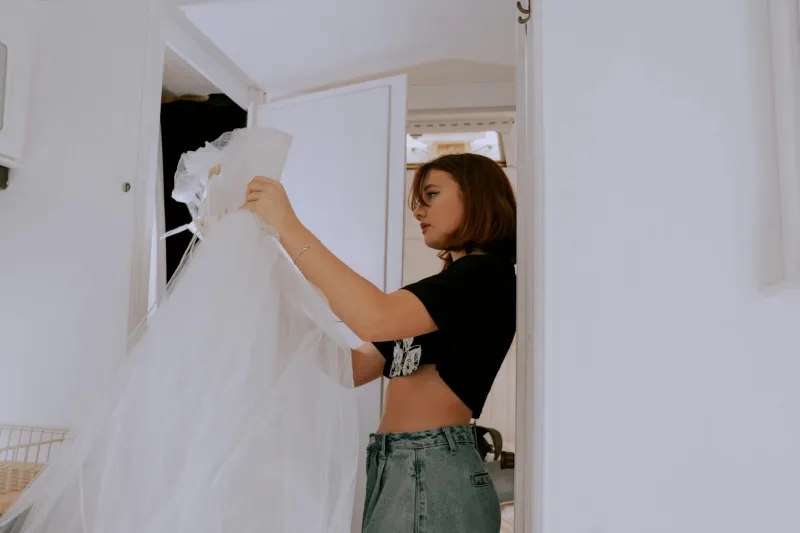
The Science of Strategic Invisibility
Sarah Mitchell thought she understood wedding guest etiquette. Don't wear white. Don't propose during the reception. Don't sleep with the groom's father. Standard stuff.
But when her college roommate's wedding invitation arrived with a seven-paragraph dress code that included phrases like "elevated casual with intentional restraint" and "mindful color choices that honor the bride's visual narrative," Sarah realized she was entering uncharted territorial waters.
So she did what any rational person would do: she hired a professional threat assessment team.
"I spent $900 on a wedding guest styling consultation," Sarah explains, sitting in her living room surrounded by fabric swatches organized by "aggression level." "My stylist, Jessica, specializes in what she calls 'calibrated gorgeousness'—looking incredible while remaining strategically forgettable."
The Rise of Ceremonial Combat Consulting
Wedding guest styling has evolved from a casual "what should I wear?" text to your sister into a sophisticated military operation involving color theory, psychological profiling, and advanced risk assessment.
"We're essentially fashion diplomats," explains Jessica Rodriguez, founder of "Appropriate Radiance," a Los Angeles-based consultancy that charges $800-$1,200 to ensure clients navigate wedding politics without accidentally committing aesthetic war crimes.
 Photo: Los Angeles, via cdn.britannica.com
"The modern wedding guest operates in a complex social ecosystem where being too dressed down suggests disrespect, but being too dressed up triggers the bride's fight-or-flight response," Rodriguez continues. "Our job is to find that sweet spot—memorable enough to justify the invitation, forgettable enough to preserve friendships."
The industry has exploded over the past three years, with over 200 certified "Guest Relations Specialists" now operating across major metropolitan areas. Services range from basic outfit approval ($150) to full "Social Camouflage Packages" that include backup outfits, emergency accessories, and real-time text support during the event.
The Algorithm of Appropriateness
Sarah's styling journey began with what Rodriguez calls "The Bride Assessment Protocol"—a 47-question survey designed to map the psychological landscape of the bride's insecurities.
"Question 12 was 'Has the bride ever commented negatively on another woman's appearance at a social event?'" Sarah recalls. "Question 23 asked about her relationship with her mother-in-law. By question 30, I felt like I was providing intelligence for a CIA operation."
The assessment revealed that Sarah's bride fell into the "High Vigilance, Medium Confidence" category—meaning she would notice everything but had enough self-assurance to not completely lose it unless directly threatened.
"This meant Sarah could wear color, but nothing that photographed too well," Rodriguez explains. "Texture was encouraged, but not anything that created interesting shadows. Jewelry was acceptable as long as it didn't catch light."
The Great Taupe Debate of 2024
The most intense part of Sarah's consultation involved a 40-minute deep dive into whether taupe qualified as a neutral or a threat.
"Taupe is fashion Switzerland," argues Dr. Amanda Chen, a color psychologist who frequently consults for wedding styling services. "It's technically neutral, but it's also sophisticated enough to make other neutrals look lazy by comparison. In the wrong lighting, taupe can absolutely read as superiority complex."
Sarah's stylist ultimately ruled taupe "conditionally acceptable" but required a signed waiver acknowledging the risks.
"We spent an entire session on backup plans in case my taupe dress photographed too elegantly," Sarah says. "Jessica made me practice slouching and developed a series of 'strategic awkward poses' to counteract any accidental gracefulness."
Technology Meets Tradition
The most cutting-edge styling services now use AI-powered photo analysis to predict how outfits will perform across different social media platforms.
"We upload client photos to our proprietary algorithm, which analyzes factors like color saturation, visual interest, and 'threat coefficient,'" explains Marcus Thompson, founder of "Wedding Guest Intelligence." "The AI can predict whether an outfit will generate more or fewer Instagram likes than the bride's dress—which is obviously crucial data."
The technology has proven remarkably accurate. In beta testing, the AI correctly predicted "aesthetic conflict potential" in 94% of cases, including one incident where it flagged a seemingly innocent blue dress that later caused a three-hour reception bathroom breakdown.
The Economics of Emotional Labor
Critics argue that the wedding guest styling industry represents the commodification of basic human consideration.
"We're literally paying people to teach us how to not accidentally hurt someone's feelings with our appearance," says Dr. Rebecca Martinez, a cultural anthropologist at NYU. "It's emotional labor as a service industry, and it's deeply weird."
But clients defend the investment as necessary insurance in an increasingly complex social landscape.
"My friend spent $30,000 on her wedding," Sarah points out. "If spending $900 ensures I don't accidentally ruin her day by looking too good, that's actually a bargain. Plus, I got three backup outfit options and a detailed explanation of why my original choice would have caused a diplomatic incident."
The Day of Reckoning
Sarah's carefully calibrated appearance at the wedding was, by all accounts, a triumph of strategic mediocrity.
"I looked lovely but not transcendent, put-together but not effortless, stylish but not inspirational," she reports. "The bride complimented my dress exactly once, which Jessica had predicted would happen during cocktail hour. The algorithm was right—I achieved perfect social camouflage."
The only minor crisis occurred when Sarah's taupe dress photographed slightly better than expected in the church lighting, causing a brief moment of panic among the bridal party. But her emergency "awkward stance protocol" successfully neutralized the threat.
Future Developments
The industry shows no signs of slowing down. Rodriguez is currently developing "Seasonal Guest Packages" for clients attending multiple weddings per year, while other companies are exploring expansion into baby showers, graduation parties, and "any event where someone might cry if you look too good."
"We're also working on a real-time monitoring app," Thompson reveals. "Guests would receive live feedback during events—like 'your smile is reading too radiant, please dial it back 15%' or 'emergency: bride approaching, activate backup personality.'"
As wedding culture continues to evolve into an increasingly complex performance of social engineering, one thing is clear: looking good has never been more dangerous, and looking appropriately good has never been more expensive.
Sarah, for her part, is already booking her stylist for next spring's wedding season. "I have four weddings coming up," she says. "I can't afford not to hire a professional. The friendship stakes are too high, and my natural instincts are apparently too threatening."